43 indexing using labels in dataframe
How to Select Columns by Index in a Pandas DataFrame If you'd like to select columns based on label indexing, you can use the .loc function. This tutorial provides an example of how to use each of these functions in practice. Example 1: Select Columns Based on Integer Indexing Label-based indexing to the Pandas DataFrame - GeeksforGeeks Indexing plays an important role in data frames. Sometimes we need to give a label-based "fancy indexing" to the Pandas Data frame. For this, we have a function in pandas known as pandas.DataFrame.lookup (). The concept of Fancy Indexing is simple which means, we have to pass an array of indices to access multiple array elements at once.
Python Pandas - Indexing and Selecting Data - Tutorials Point Pandas provide various methods to have purely label based indexing. When slicing, the start bound is also included. Integers are valid labels, but they refer to the label and not the position. .loc () has multiple access methods like − A single scalar label A list of labels A slice object A Boolean array

Indexing using labels in dataframe
Pandas Boolean Indexing: How to Use Boolean Indexing Pandas Boolean Indexing. Pandas boolean indexing is a standard procedure. We will select the subsets of data based on the actual values in the DataFrame and not on their row/column labels or integer locations. Pandas indexing operators "&" and "|" provide easy access to select values from Pandas data structures across various use cases. How to Filter a Pandas DataFrame With a Multi-Level Column Index ... The dataframe where data under the "AAPL" column label in the "Close" column is greater than 100. Notice that we used a "." to navigate the first column label. How to Select Rows by Index in a Pandas DataFrame - Statology If you'd like to select rows based on label indexing, you can use the .loc function. This tutorial provides an example of how to use each of these functions in practice. Example 1: Select Rows Based on Integer Indexing. The following code shows how to create a pandas DataFrame and use .iloc to select the row with an index integer value of 4:
Indexing using labels in dataframe. Tutorial: How to Index DataFrames in Pandas - Dataquest Let's explore four methods of label-based dataframe indexing: using the indexing operator [], attribute operator ., loc indexer, and at indexer. Using the Indexing Operator If we need to select all data from one or multiple columns of a pandas dataframe, we can simply use the indexing operator []. How to Index Data in Pandas with Python - Medium Using Single Label. One way we can specify which rows and/or columns we want is by using labels. For rows, the label is the index value of that row, and for columns, the column name is the label. For example, in our ufo dataframe, if we want the fifth row only along with all the columns, we would use the following: ufo.loc [4, :] How to get the names (titles or labels) of a pandas data frame in python To get the names of the data frame rows: >>> df.index Index(['Alice', 'Bob', 'Emma'], dtype='object') Get the row names of a pandas data frame (Exemple 2) Another example using the csv file train.csv (that can be downloaded on kaggle): >>> import pandas as pd >>> df = pd.read_csv('train.csv') >>> df.index RangeIndex(start=0, stop=1460, step=1) Pandas: Create an index labels by using 64-bit integers, floating-point ... Have another way to solve this solution? Contribute your code (and comments) through Disqus. Previous: Write a Pandas program to display the default index and set a column as an Index in a given dataframe and then reset the index. Next: Write a Pandas program to create a DataFrame using intervals as an index.
Boolean Indexing in Pandas - Tutorials Point Now, we can pass the boolean vector to the DataFrame to access the data. Example # passing boolean vector to data_frame index print(data_frame[ [True, True, False]]) Output If run the above code, you will get the following results. We got the row only that is True. Name Age 0 Hafeez 19 1 Srikanth 20 Conclusion Pandas DataFrame Indexing - KDnuggets In pandas data frames, each row also has a name. By default, this label is just the row number. However, you can set one of your columns to be the index of your DataFrame, which means that its values will be used as row labels. We set the column 'name' as our index. It is a common operation to pick out one of the DataFrame's columns to work on. Pandas Set Column as Index in DataFrame - Spark by {Examples} Use DataFrame.set_index() method to set the existing column of DataFrame as an index. On DataFrame, the row label is an Index. If your DataFrame has already had an Index, this replaces the existing index or expands on it. You can set the DataFrame index (row labels) using one or more existing columns or arrays (of the correct length). Syntax: How to find index of value in Pandas dataframe - DevEnum.com 2. df.index.values to Find index of specific Value. To find the indexes of the specific value that match the given condition in Pandas dataframe we will use df ['Subject'] to match the given values and index. values to find an index of matched value. The result shows us that rows 0,1,2 have the value 'Math' in the Subject column.
Pandas : Sort a DataFrame based on column names or row index labels ... In the Python Pandas Library, the Dataframe section provides a member sort sort_index () to edit DataFrame based on label names next to the axis i.e. DataFrame.sort_index (axis=0, level=None, ascending=True, inplace=False, kind='quicksort', na_position='last', sort_remaining=True, by=None) Where, Indexing and selecting data — pandas 1.4.2 documentation pandas provides a suite of methods in order to have purely label based indexing. This is a strict inclusion based protocol. Every label asked for must be in the index, or a KeyError will be raised. When slicing, both the start bound AND the stop bound are included, if present in the index. Set Index in pandas DataFrame - PYnative We need to pass the column or list of column labels as input to the DataFrame.set_index () function to set it as an index of DataFrame. By default, these new index columns are deleted from the DataFrame. df = df.set_index ( ['col_label1', 'col_label2'…]) Set the index in place. We can use the parameter inplace to set the index in the existing ... Pandas DataFrame Indexing: Set the Index of a Pandas Dataframe Python list as the index of the DataFrame In this method, we can set the index of the Pandas DataFrame object using the pd.Index (), range (), and set_index () function. First, we will create a Python sequence of numbers using the range () function then pass it to the pd.Index () function which returns the DataFrame index object.
Indexing in Pandas - MonkeyBean
How to Get the Index of a Dataframe in Python Pandas? Method 1: Using for loop. In Python, we can easily get the index or rows of a pandas DataFrame object using a for loop. In this method, we will create a pandas DataFrame object from a Python dictionary using the pd.DataFrame () function of pandas module in Python. Then we will run a for loop over the pandas DataFrame index object to print the ...
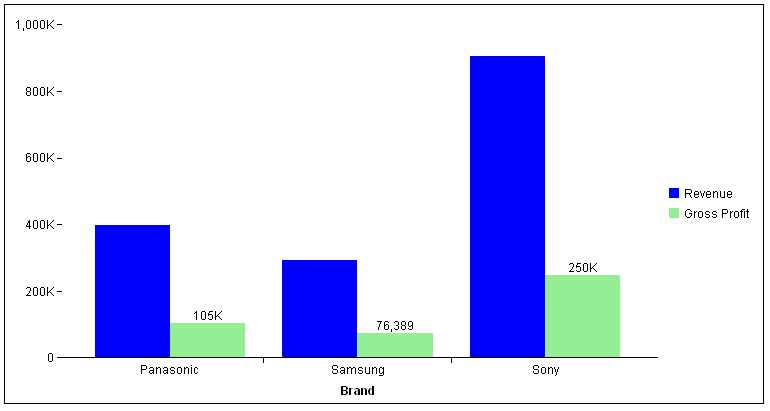
Showing and Formatting Data Text Labels
Indexing in Pandas Dataframe using Python - Medium Indexing using .loc method. If we use the .loc method, we have to pass the data using its Label name. Single Row To display a single row from the dataframe, we will mention the row's index name in the .loc method. The whole row information will display like this, Single Row information Multiple Rows

Automated Data Labeling vs Manual Data Labeling
Pandas Indexing Examples: Accessing and Setting Values on DataFrames Source dataframe select row whose index label is 0 select rows whose index labels are 2 and 3 loc example, string index Use .loc [] to select rows based on their string labels:
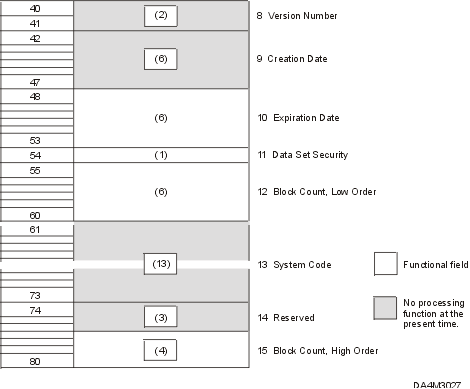
Format of IBM standard data set label 1 (HDR1/EOV1/EOF1)
Python Pandas: Get Index Label for a Value in a DataFrame If I know the value in 'hair' is 'blonde', how do I get the index label (not integer location) corresponding to df.ix['mary','hair']? (In other words, I want to get 'mary' knowing that hair is 'blonde'). If I wanted the integer value of the index I'd use get_loc. But I want the label. Thanks in advance.

Python Pandas Re-indexing In A DataFrame | Python | cppsecrets.com
Indexing and Sorting a dataframe using iloc and loc Labels based indexing using loc. To index a dataframe based on column names, loc can be used. For example, to get all the columns between petal_length till iris class and records from 2nd to 10th, can be extracted by using - ... Simples way to sort a dataframe can be done using sort_values function of pandas dataframe, which take the column ...
KB36266: Documents containing graphs with rotated data labels display data labels without ...
Indexing a Pandas DataFrame for people who don't like to remember things In pandas data frames, each row also has a name. By default, this label is just the row number. However, you can set one of your columns to be the index of your DataFrame, which means that its values will be used as row labels. We set the column 'name' as our index. It is a common operation to pick out one of the DataFrame's columns to work on.

Pandas Drop: Delete DataFrame Rows & Columns | Shane Lynn
Pandas Select Rows by Index (Position/Label) In this article, I will explain how to select rows from pandas DataFrame by integer index and label, by the range, and selecting first and last n rows with several examples. loc [] & iloc [] operators are also used to select columns from pandas DataFrame and refer to related article how to get cell value from pandas DataFrame.

Showing and Formatting Data Text Labels
Indexing and Selecting Data with Pandas - GeeksforGeeks Output: Indexing a DataFrame using .loc[ ]: This function selects data by the label of the rows and columns. The df.loc indexer selects data in a different way than just the indexing operator. It can select subsets of rows or columns. It can also simultaneously select subsets of rows and columns.
Issue: Part Labels Display Incorrect Barcode Data when Processing to Multiple Machines in 15.6
Pandas index column title or name - Stack Overflow 2 Aug 2013 — it should be possible to specify index name at DataFrame creation time. e.g. pd.DataFrame(values,index={"INDEX_NAME":index_values}) . I do not ...9 answers · Top answer: You can just get/set the index via its name property In [7]: df.index.name Out[7]: ...Pandas - remove the label of the column index - Stack Overflow28 Oct 2018Selecting a row of pandas series/dataframe by integer index19 Apr 2013Indexing Pandas data frames: integer rows, named columns26 Feb 2015How to read in Pandas DataFrame while ignoring index and ...4 Feb 2020More results from stackoverflow.com

Python Pandas Re-indexing In A DataFrame | Python | cppsecrets.com
Working With Specific Values In Pandas DataFrame - Data Courses This function of a pandas DataFrame is of high value as you can build an index using a specific column, (meaning: a label) that you want to use for managing and querying your data. For example, one can develop an index from a column of values and then use the attribute.loc to select data from pandas DataFrame based on a value found in the index.
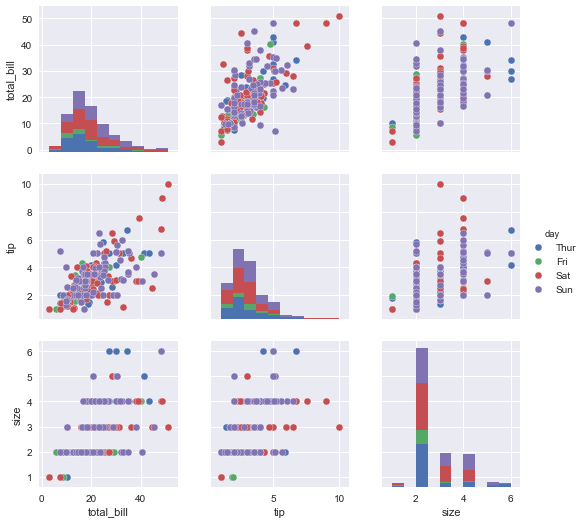
33 The Label Is Not In The Index Pandas - Understandingluan
Pandas filter(): Select Columns and Rows by Labels in a Dataframe It primarily use labels of dataframe to subset a dataframe. Here we will see examples of how to is Pandas filter() function to select one or more columns using the column names and select one or more rows using row indices. ... Our toy dataframe' row index is integer. For the sake of easiness, let us change the row index to be string instead ...
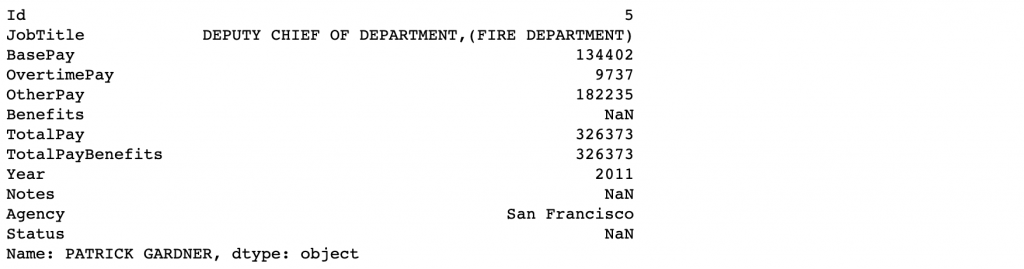
Three Basic Data Analyzing Methods In Pandas | by Munia Humaira | Level Up Coding
pandas.DataFrame.set_index — pandas 1.4.2 documentation DataFrame.set_index(keys, drop=True, append=False, inplace=False, verify_integrity=False) [source] ¶ Set the DataFrame index using existing columns. Set the DataFrame index (row labels) using one or more existing columns or arrays (of the correct length). The index can replace the existing index or expand on it. Parameters

python - Efficient way to get indices of column-labels from pd.DataFrame - Stack Overflow
How to Select Rows by Index in a Pandas DataFrame - Statology If you'd like to select rows based on label indexing, you can use the .loc function. This tutorial provides an example of how to use each of these functions in practice. Example 1: Select Rows Based on Integer Indexing. The following code shows how to create a pandas DataFrame and use .iloc to select the row with an index integer value of 4:
Issue: Part Labels Display Incorrect Barcode Data when Processing to Multiple Machines in 15.6
How to Filter a Pandas DataFrame With a Multi-Level Column Index ... The dataframe where data under the "AAPL" column label in the "Close" column is greater than 100. Notice that we used a "." to navigate the first column label.
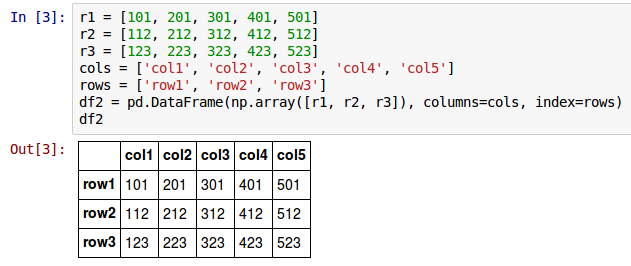
Exploring Pandas DataFrame
Pandas Boolean Indexing: How to Use Boolean Indexing Pandas Boolean Indexing. Pandas boolean indexing is a standard procedure. We will select the subsets of data based on the actual values in the DataFrame and not on their row/column labels or integer locations. Pandas indexing operators "&" and "|" provide easy access to select values from Pandas data structures across various use cases.

Graphing Data from Multiple Dynamic Applications in a Single Dashboard Widget
Post a Comment for "43 indexing using labels in dataframe"